

Support

Help you fully understand Calterah

What are the technological advantages of Calterah CMOS mmWave radar SoCs?

The core technological advantages of Calterah CMOS mmWave radar SoCs are:

  • High integration
  • CMOS process that enables mass production with low cost
  • Innovative Antenna-in-Package (AiP) design

How to understand the advantage of high integration of Calterah mmWave radar chips? What are the benefits of high integration?

Different from traditional mmWave radar transceivers, Calterah's mass-produced mmWave radar chips are based on the CMOS process for realizing the system-on-chip (SoC) design. Each chip device basically integrates all the components required by a radar system, including RF front-end, analog baseband, radar signal processing accelerator, high-performance processors, and communication interfaces, with outstanding advantages in Power, Performance, and Area (PPA). The highly-integrated Calterah SoCs greatly simplify the design of radar modules and lower the cost of radar systems.

What are Calterah’s technical advantages in the UWB field?

With over a decade of experience in mmWave radar chips and a track record of shipping tens of millions of automotive-grade chips, Calterah integrates this expertise into UWB chip design. With rigorously tested RF hardware, mature signal processing algorithms, and radar SDKs ready for integration, Calterah’s UWB chips feature automotive-grade reliability and unique versatility for ranging and radar sensing applications. They can filter out real-world interference in automotive scenarios, significantly shortening development cycles and reducing risks in mass production. 

Meanwhile, Calterah is deeply involved in UWB standard development and technology evolution, holding five voting member positions within the IEEE 802.15 Working Group for Wireless Specialty Networks (WSN), having contributed three core patents and about 40 proposals*. The company has also published a White Paper on MMS UWB Operation in IEEE 802.15.4ab. Additionally, as Vice Chair of China Market Task Group of Car Connectivity Consortium (CCC), Li Wenzheng, Technical Marketing Engineer at Calterah, has participated in multiple members meetings and shared the latest UWB technology advancements, demonstrating Calterah's comprehensive capabilities in both UWB chips and industry standards.

*Data as of July 31, 2026.

What are the advantages of the 2-transmit, 4-receive (2T4R) architecture in Calterah’s Dubhe UWB chip?

Compared to common 1T2R solutions, Calterah Dubhe chip with a 2T4R architecture brings more signal dimensions. The key advantages include:

  • Superior angular resolution: In communication mode, the chip enables angle measurement based on 3D Phase Difference of Arrival (PDoA)—simultaneously measuring both azimuth and elevation—without requiring an external RF switch. In radar mode, it forms up to 7 virtual channels using the Multiple-Input Multiple-Output (MIMO) technology, supporting UWB radar point cloud output and significantly improving angular resolution.
  • Enhanced spatial awareness and robustness against interference: With this hardware architecture, Dubhe can enable reliable ranging and sensing in complex scenarios, such as stable non-line-of-sight (NLoS) positioning in underground parking lots, detecting vital signs inside car cabins, and kick sensing for tailgates.

What is Calterah's BLE-assisted MMS UWB ranging solution, and what are its advantages in real-world applications?

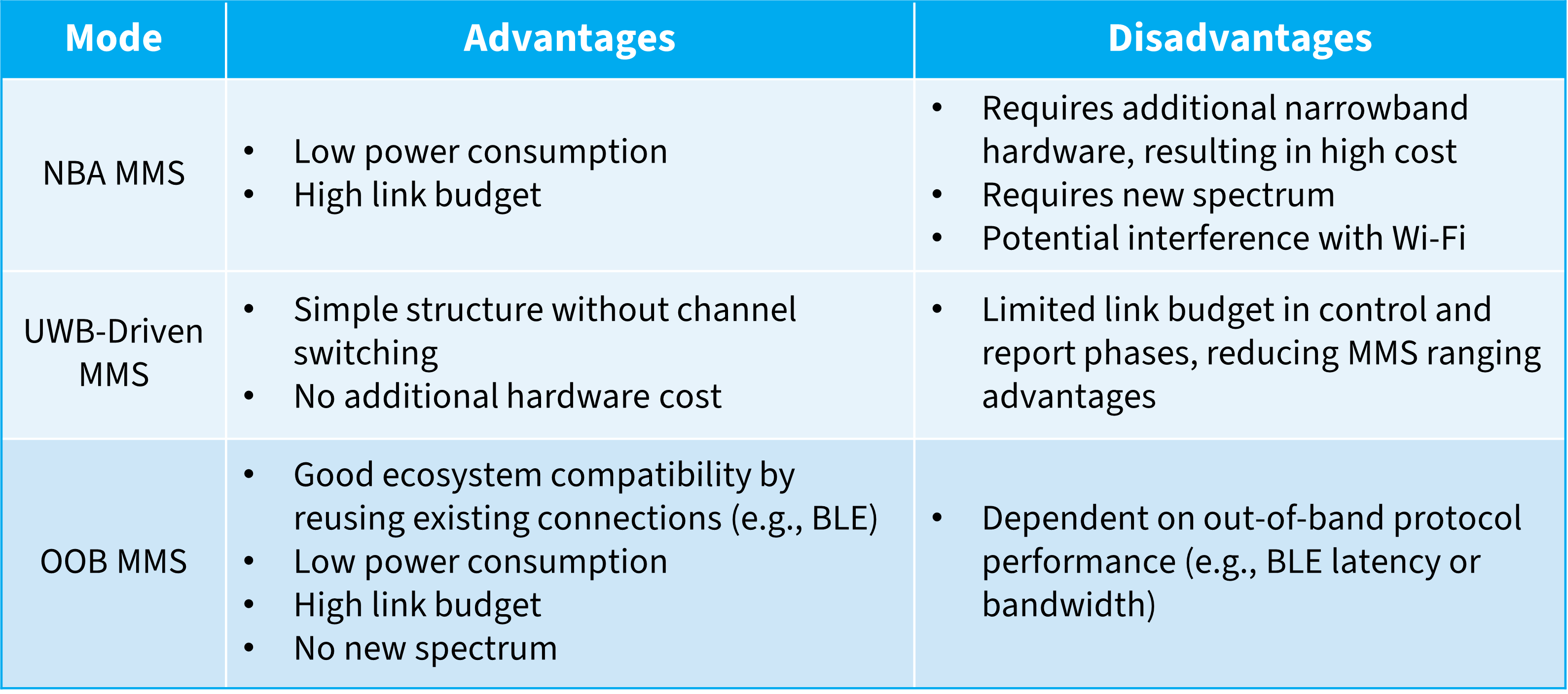
IEEE 802.15.4ab introduces three Multi-Millisecond (MMS) UWB modes:

  • Narrowband-Assisted (NBA) MMS UWB
  • UWB-Driven MMS UWB
  • Out-of-Band (OOB) MMS UWB

Calterah's Dubhe UWB chip uses Bluetooth Low Energy (BLE)-assisted MMS in the OOB MMS mode. As an ecosystem-friendly and cost-optimized approach, it also maximizes performance.

Owing to the BLE-assisted MMS mode, Calterah's Dubhe UWB chip fully leverages the ranging capability of the MMS technology, achieving a ranging distance of up to 400 meters. Its strong signal penetration ensures stable operation even in complex environments. At the same time, it makes full use of the existing Bluetooth ecosystem, avoiding additional hardware costs. Calterah's BLE-assisted MMS UWB ranging solution focuses on addressing pain points in digital key applications for smart cars, delivering precise long-distance car locating and smooth, hands-free locking and unlocking.

What is the AiP technology? What are its advantages in practical application?

AiP is short for Antenna in Package. Different from traditional independent antennas, the AiP technology from Calterah integrates antennas into the package substrates or structures of chips, realizing the integration of SoC and RF signal transmission and receiving. Compared against chips with standard packages, the mmWave radar SoCs with AiP can further enhance the integration of radar modules and reduce their sizes and cost. Furthermore, AiP allows high consistency and precision of antenna production without external connection or radiation loss, and lowers the design threshold.

Calterah is a world-leading enterprise in the mass production of mmWave radar SoCs with AiP. Over the years, Calterah has been continuously optimizing the AiP technology. Currently, Calterah radar SoCs with AiP have been widely applied in automotive scenarios with strict installation requirements, such as door radar and in-cabin radar, as well as in smart home, elderly care, and other industrial and consumer fields. 

What is the RoP® technology? What are its advantages in practical application?

RoP® is short for Radiator on Package, the most advanced and innovative mmWave packaging technology of Calterah. This technology directly transmits signals to the waveguide antenna system through radiators, significantly reducing antenna feedline loss and enhancing channel isolation, thereby achieving great performance improvement.

Currently, Calterah's RoP® technology is applied to the Alps-Pro and Andes SoCs. Working with the waveguide antenna system, the SoCs with RoP® significantly enhance the detection performance and angular resolution capability of radar, facilitating the realization of high-performance radar for intelligent driving.

What applications can Calterah chips achieve? And what certifications does Calterah have?

Calterah mmWave radar SoCs are used in automotive, industrial, and consumer electronics markets, with automotive-grade chips widely applied in Advanced Driver Assistance Systems (ADAS) and autonomous driving, such as corner radar, forward-looking radar, imaging radar, in-cabin radar, door radar, etc.

Calterah's Dubhe series of UWB SoCs is the world's first product family based on the new IEEE 802.15.4ab standard. Covering automotive, industrial, and consumer applications, it enables precise positioning and radar sensing, unlocking various use cases such as intelligent automotive interaction, smart connectivity, smart home, and smart interaction with consumer electronics.

Calterah has established a comprehensive management system covering the full lifecycle of SoCs, compliant with the ISO 9001 quality standard, AEC-Q100 reliability standard, ISO 26262 functional safety standard, ISO/SAE 21434 cybersecurity standard, ASPICE standard for automotive software, ISO 27001 information security standard, TISAX standard, and TMMi standard.

Calterah automotive-grade SoCs meet the reliability requirements of AEC-Q100, and the automotive-grade mmWave SoC products reach the ASIL-B level of functional safety.

Calterah UWB SoCs comply with the IEEE 802.15.4, IEEE 802.15.4z, and IEEE 802.15.4ab standards, have obtained FiRa Core 4.0 certification, and meet the requirements of CCC DK 3.0, ICCOA DK 3.0, and the ICCE UWB digital car key standard.

After purchasing Calterah chip products, what technical resources and support will Calterah offer?

Calterah offers a set of complete solutions covering all scenarios to help customers shorten the time to market.

  • Software and hardware reference designs: Calterah offers easy-to-use software and hardware reference designs, covering intelligent assisted driving, smart interaction, and consumer electronics, to shorten the product development cycles of customers.
  • Complete radar signal processing SDKs: Calterah offers comprehensive SDKs to advance the software development of radar applications.
  • Complete underlying PHY and MAC software protocol for UWB communication.
  • Responsive field application engineering (FAE) support: Calterah's professional FAE team offers you reliable technical support and field services.

What capabilities does Calterah have in terms of mass production testing?

The mass production of high-frequency automotive-grade chips requires reliable and cost-effective automated testing. Traditional automatic test equipment available on the market was only suitable for low-frequency chips. For high-frequency mmWave chips, Calterah boasts mass production testing solutions developed in-house from scratch, including customized and complete high-frequency mmWave chip testing hardware, building high-precision over-the-air test chambers for AiP chip testing, and establishing the Calterah ATE clean lab—J Lab to further develop testing programs.

Calterah's R&D investment and results in the mass production testing solutions for high-frequency mmWave chips, have also helped enrich the technical capabilities of China's automotive chip supply chain in the high-frequency chip testing.

How to distinguish between automotive-grade, industrial-grade, and consumer-grade chips by Calterah’s SoC part numbers?

The suffixes in the Calterah SoC part numbers can help you distinguish between automotive-grade chips, industrial-grade chips and consumer-grade chips.

An SoC whose part number suffix begins with “A” is an automotive-grade chip, such as CAL77S224-AE, CAL77S344-AE and CAL1106AQ.

An SoC whose part number suffix begins with “I” is an industrial-grade chip, such as CAL77S244-IB and CAL60S244-IE.

An SoC whose part number suffix begins with “C” is a consumer-grade chip, such as CAL1106CQ and CAL1104CQ.

Submit Questions

If you have any questions, please contact sales@calterah.com.